Metal Heater Thermal Simulation and Phase-Shifter Efficiency (FEM)
GDSFactory has an FEM femwell plugin that you can use for thermal simulations. You can simulate directly the component layout and include important effects such as metal dummy fill.
# !uv add femwell  # uncomment to install
#! uvx inc run gmsh
# Config: filepaths, PDK activation, package imports and selected source
import gdsfactoryplus as gfp

pdk = gfp.get_pdk()
pdk.activate()
from collections import OrderedDict
from functools import partial

import gdsfactory as gf
import matplotlib.pyplot as plt
import numpy as np
from femwell.maxwell.waveguide import compute_modes
from femwell.mesh import mesh_from_OrderedDict
from femwell.thermal import solve_thermal
from gdsfactory.add_padding import add_padding, add_padding_container
from gdsfactory.generic_tech import get_generic_pdk
from gdsfactory.generic_tech.layer_map import LAYER
from gplugins.common.utils.geometry import region_to_shapely_polygons
from shapely.geometry import LineString, Polygon
from skfem import Basis, ElementTriP0
from skfem.io import from_meshio
from tqdm.auto import tqdm
gf.config.rich_output()
PDK = get_generic_pdk()
PDK.activate()

LAYER_STACK = PDK.layer_stack

LAYER_STACK.layers["heater"].thickness = 0.13
LAYER_STACK.layers["heater"].zmin = 2.2

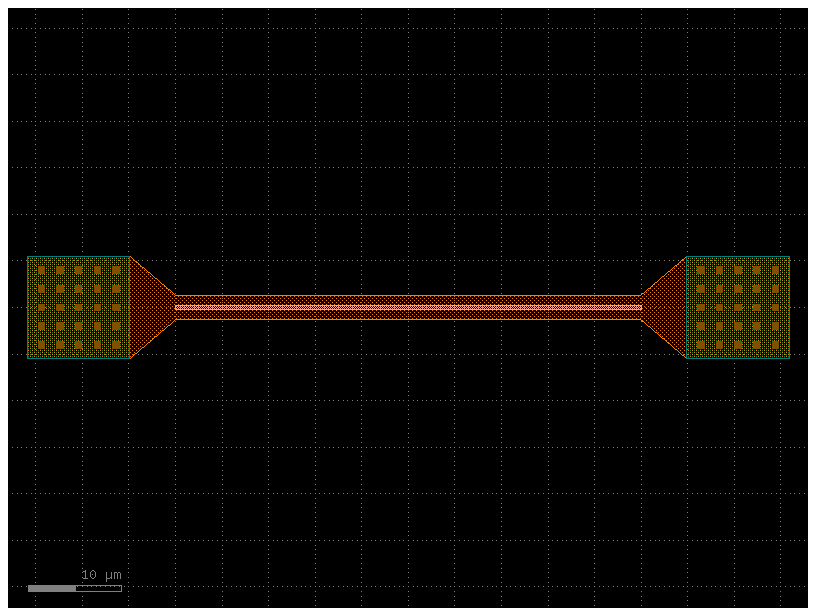
heater = gf.components.straight_heater_metal(length=50)
heater.plot()
w_sim = 16
h_substrate = 0.5
layer_names = ["core", "heater", "clad", "box", "substrate"]

heater_padded = add_padding_container(
    component=heater,
    function=partial(add_padding, layers=(LAYER.WAFER,), default=w_sim / 2),
)

x_center = (heater.dxmin + heater.dxmax) / 2
xsection_line = LineString([(x_center, -w_sim / 2), (x_center, w_sim / 2)])

substrate_bottom = LAYER_STACK.layers["box"].zmin - h_substrate
polygons = OrderedDict(
    bottom=LineString([(-w_sim / 2, substrate_bottom), (w_sim / 2, substrate_bottom)])
)

for layer_name in layer_names:
    layer_level = LAYER_STACK.layers[layer_name]
    region = layer_level.layer.get_shapes(heater_padded)
    if region.is_empty():
        continue

    shapely_polys = region_to_shapely_polygons(region)
    if not shapely_polys:
        continue

    zmin = layer_level.zmin
    thickness = layer_level.thickness
    if layer_name == "substrate":
        zmin = substrate_bottom
        thickness = h_substrate
    zmax = zmin + thickness

    for poly in (
        shapely_polys.geoms if hasattr(shapely_polys, "geoms") else [shapely_polys]
    ):
        intersection = poly.intersection(xsection_line)
        if intersection.is_empty:
            continue
        for geom in (
            intersection.geoms if hasattr(intersection, "geoms") else [intersection]
        ):
            y_min, y_max = geom.bounds[1], geom.bounds[3]
            rect = Polygon([(y_min, zmin), (y_max, zmin), (y_max, zmax), (y_min, zmax)])
            if layer_name in polygons:
                polygons[layer_name] = polygons[layer_name].union(rect)
            else:
                polygons[layer_name] = rect

resolutions = dict(
    core={"resolution": 0.04, "distance": 1},
    clad={"resolution": 0.6, "distance": 1},
    box={"resolution": 0.6, "distance": 1},
    heater={"resolution": 0.1, "distance": 1},
)

mesh = from_meshio(
    mesh_from_OrderedDict(polygons, resolutions, default_resolution_max=0.6)
)
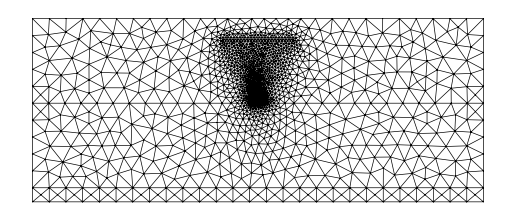
mesh.draw().show()
And then we solve it!
currents = np.linspace(0.0, 7.4e-3, 10)
current_densities = currents / polygons["heater"].area
neffs = []

for current_density in tqdm(current_densities):
    basis0 = Basis(mesh, ElementTriP0(), intorder=4)
    thermal_conductivity_p0 = basis0.zeros()
    for domain, value in {
        "core": 90,
        "box": 1.38,
        "clad": 1.38,
        "heater": 28,
        "substrate": 148,
    }.items():
        thermal_conductivity_p0[basis0.get_dofs(elements=domain)] = value
    thermal_conductivity_p0 *= 1e-12  # 1e-12 -> conversion from 1/m^2 -> 1/um^2

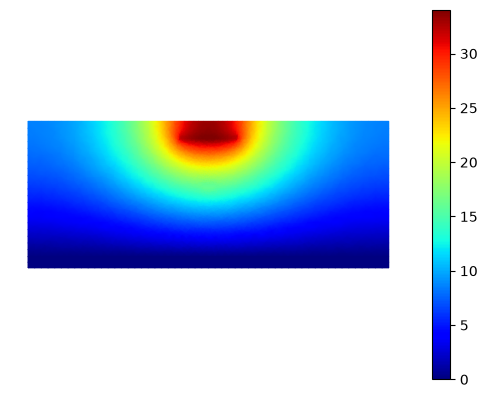
    basis, temperature = solve_thermal(
        basis0,
        thermal_conductivity_p0,
        specific_conductivity={"heater": 2.3e6},
        current_densities={"heater": current_density},
        fixed_boundaries={"bottom": 0},
    )

    if current_density == current_densities[-1]:
        basis.plot(temperature, shading="gouraud", colorbar=True)
        plt.show()

    temperature0 = basis0.project(basis.interpolate(temperature))
    epsilon = basis0.zeros() + (1.444 + 1.00e-5 * temperature0) ** 2
    epsilon[basis0.get_dofs(elements="core")] = (
        3.4777 + 1.86e-4 * temperature0[basis0.get_dofs(elements="core")]
    ) ** 2

    modes = compute_modes(basis0, epsilon, wavelength=1.55, num_modes=1, solver="scipy")

    if current_density == current_densities[-1]:
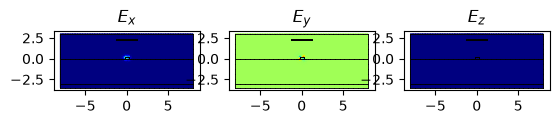
        modes[0].plot(modes[0].E.real, colorbar=False, direction="x")
        plt.show()

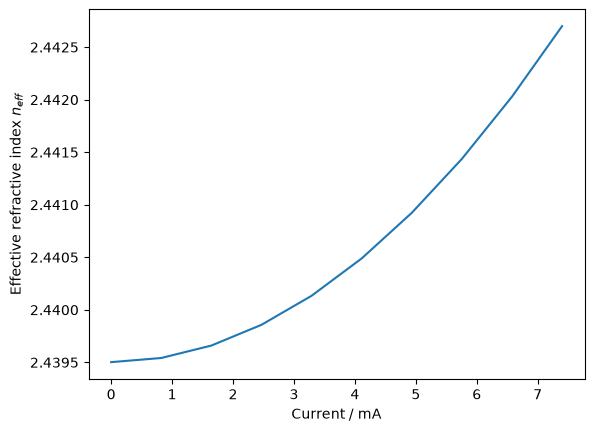
    neffs.append(np.real(modes[0].n_eff))

length = 320  # um
print(f"Phase shift: {2 * np.pi / 1.55 * (neffs[-1] - neffs[0]) * length}")
plt.xlabel("Current / mA")
plt.ylabel("Effective refractive index $n_{eff}$")
plt.plot(currents * 1e3, neffs)
plt.show()