Coupling to the continuum#
# !uv add femwell  # uncomment to install
#! uvx inc run gmsh
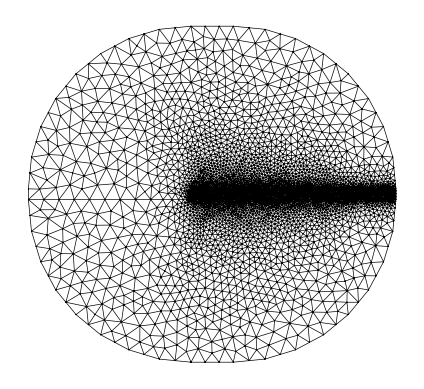
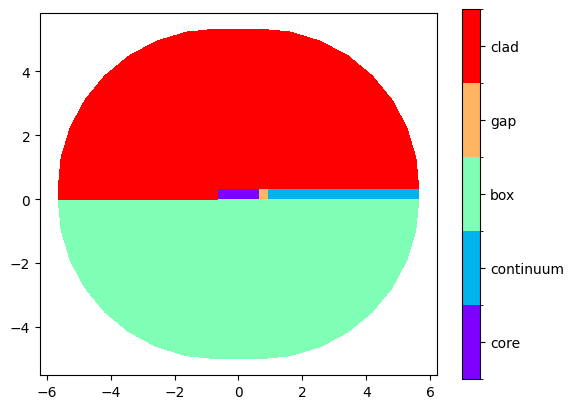
Let’s do a simple rectangular waveguide. Next to it we put a a slab of the same height and material, but wider, to which the field in the wavegudie couples. As we later add a PML to the simulation, this slab approximates an infinite wide wavegudie.
wg_width = 1.3
wg_thickness = 0.33
gap_width = 0.3
buffer = 5
pml_offset = 0.5
core = shapely.geometry.box(-wg_width / 2, 0, +wg_width / 2, wg_thickness)
gap = shapely.geometry.box(wg_width / 2, 0, +wg_width / 2 + gap_width, wg_thickness)
continuum = shapely.geometry.box(
    wg_width / 2 + gap_width, 0, +wg_width / 2 + buffer, wg_thickness
)
env = core.buffer(5, resolution=8)

polygons = OrderedDict(
    core=core,
    gap=gap,
    continuum=continuum,
    box=clip_by_rect(env, -np.inf, -np.inf, np.inf, 0),
    clad=clip_by_rect(env, -np.inf, 0, np.inf, np.inf),
)

resolutions = dict(
    core={"resolution": 0.05, "distance": 1},
    gap={"resolution": 0.05, "distance": 1},
    continuum={"resolution": 0.05, "distance": 1},
)

mesh = from_meshio(
    mesh_from_OrderedDict(polygons, resolutions, default_resolution_max=0.5)
)
mesh.draw().show()

plot_domains(mesh)
plt.show()
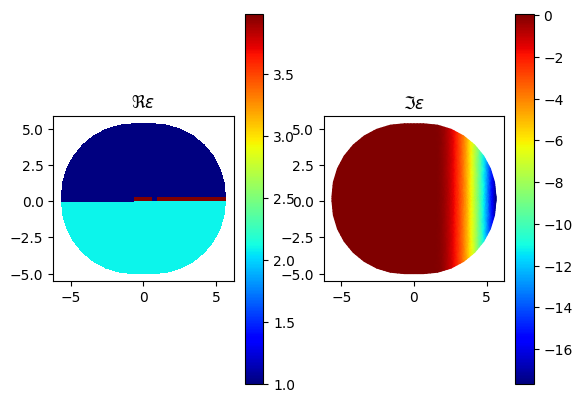
Now we define the epsilon! We add an PML on the right hand-side by adding an imaginary part to the epsilon.
basis0 = Basis(mesh, ElementDG(ElementTriP1()))
epsilon = basis0.zeros(dtype=complex)
for subdomain, n in {
    "core": 1.9963,
    "box": 1.444,
    "gap": 1.0,
    "continuum": 1.9963,
    "clad": 1,
}.items():
    epsilon[basis0.get_dofs(elements=subdomain)] = n**2
epsilon += basis0.project(
    lambda x: -1j * np.maximum(0, x[0] - (wg_width / 2 + gap_width + pml_offset)) ** 2,
    dtype=complex,
)
fig, axs = plt.subplots(1, 2)
for ax in axs:
    ax.set_aspect(1)
axs[0].set_title(r"$\Re\epsilon$")
basis0.plot(epsilon.real, colorbar=True, ax=axs[0])
axs[1].set_title(r"$\Im\epsilon$")
basis0.plot(epsilon.imag, shading="gouraud", colorbar=True, ax=axs[1])
plt.show()
Now let’s calculate the mode of the wavegudie! We calculate the propagation loss from the imaginary part of the effective refractive index.
wavelength = 1.55

modes = compute_modes(basis0, epsilon, wavelength=wavelength, num_modes=1, order=1)
for mode in modes:
    print(
        f"Effective refractive index: {mode.n_eff:.12f}, "
        f"Loss: {mode.calculate_propagation_loss(distance=1):4f} / dB/um"
    )
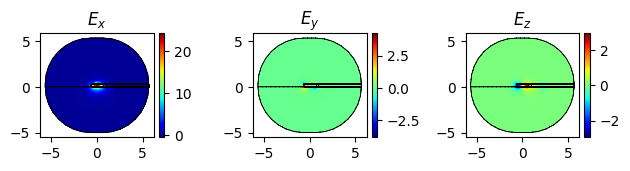
    mode.plot(mode.E.real, colorbar=True, direction="x")
    plt.show()
Effective refractive index: 1.566634432079-0.000457954301j, Loss: 0.016124 / dB/um