
Bent waveguide losses#
This example uses an effective epsilon approximation for the bent, for more precise implementation see julia example.
# !uv add femwell  # uncomment to install
#! uvx inc run gmsh
We describe the geometry using shapely. In this case it’s simple: we use a shapely.box for the waveguide. For the surrounding we buffer the core and clip it to the part below the waveguide for the box. The remaining buffer is used as the clad. For the core we set the resolution to 30nm and let it fall of over 500nm
wavelength = 1.55

wg_width = 0.5
wg_thickness = 0.22
slab_thickness = 0.11

core_index = 3.48
slab_index = 3.48

clad_index = 1.44
box_index = 1.44

pml_distance = wg_width / 2 + 2  # distance from center
pml_thickness = 2
core = box(-wg_width / 2, 0, wg_width / 2, wg_thickness)
slab = box(-1 - wg_width / 2, 0, pml_distance + pml_thickness, slab_thickness)
env = box(-1 - wg_width / 2, -1, pml_distance + pml_thickness, wg_thickness + 1)

polygons = OrderedDict(
    core=core,
    slab=slab,
    box=clip_by_rect(env, -np.inf, -np.inf, np.inf, 0),
    clad=clip_by_rect(env, -np.inf, 0, np.inf, np.inf),
)

resolutions = dict(
    core={"resolution": 0.03, "distance": 1}, slab={"resolution": 0.1, "distance": 0.5}
)

mesh = from_meshio(
    mesh_from_OrderedDict(
        polygons, resolutions, default_resolution_max=0.2, filename="mesh.msh"
    )
)
mesh.draw().show()
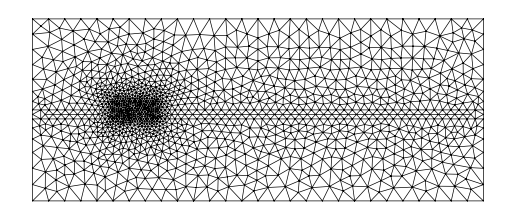
On this mesh, we define the epsilon. We do this by setting domainwise the epsilon to the squared refractive index. We additionally add a PML layer bt adding a imaginary part to the epsilon
basis0 = Basis(mesh, ElementDG(ElementTriP1()))
epsilon = basis0.zeros(dtype=complex)
for subdomain, n in {
    "core": core_index,
    "slab": slab_index,
    "box": box_index,
    "clad": clad_index,
}.items():
    epsilon[basis0.get_dofs(elements=subdomain)] = n**2
epsilon += basis0.project(
    lambda x: -10j * np.maximum(0, x[0] - pml_distance) ** 2,
    dtype=complex,
)
basis0.plot(epsilon.real, shading="gouraud", colorbar=True).show()
basis0.plot(epsilon.imag, shading="gouraud", colorbar=True).show()
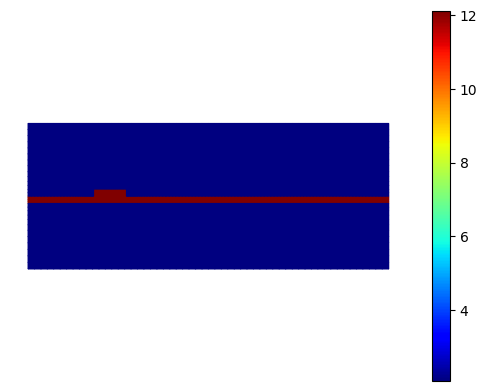
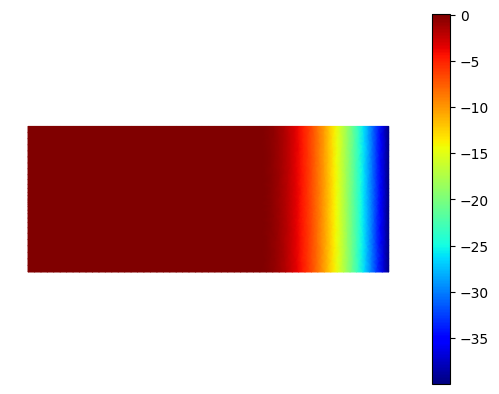
We calculate now the modes for the geometry we just set up. We do it first for the case, where the bend-radius is infinite, i.e. a straight waveguide. This is done to have a reference effectie refractive index for starting and for mode overlap calculations between straight and bent waveguides.
modes_straight = compute_modes(
    basis0, epsilon, wavelength=wavelength, num_modes=1, order=2, radius=np.inf
)
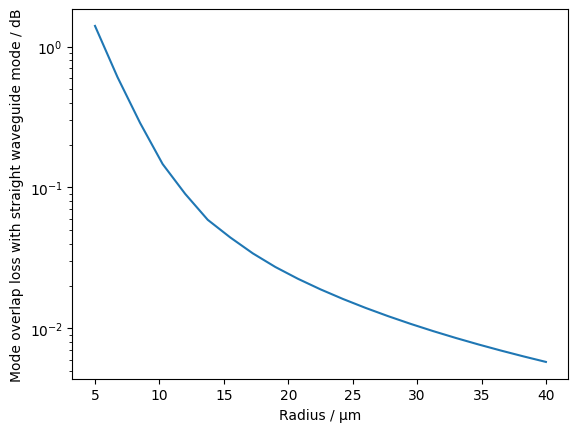
Now we calculate the modes of bent waveguides with different radii. Subsequently, we calculate the overlap integrals between the modes to determine the coupling efficiency And determine from the imaginary part the bend loss.
radiuss = np.linspace(40, 5, 21)
radiuss_lams = []
overlaps = []
lam_guess = modes_straight[0].n_eff
for radius in tqdm(radiuss):
    modes = compute_modes(
        basis0,
        epsilon,
        wavelength=wavelength,
        num_modes=1,
        order=2,
        radius=radius,
        n_guess=lam_guess,
        solver="scipy",
    )
    lam_guess = modes[0].n_eff
    radiuss_lams.append(modes[0].n_eff)

    overlaps.append(modes_straight[0].calculate_overlap(modes[0]))
And now we plot it!
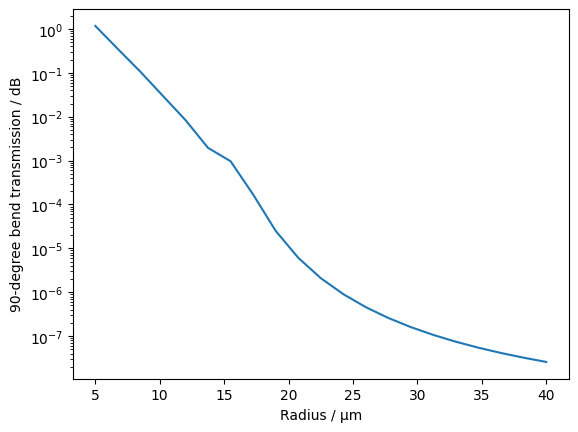
We now plot the mode calculated for the smallest bend radius to check that it’s still within the waveguide. As modes can have complex fields as soon as the epsilon gets complex, so we get a complex field for each mode. Here we show only the real part of the mode.
Effective refractive index: 2.64348503506180-0.00848240209447j
